



Program
The following material is provided as a service collecting information related to magnetism. It is a free of charge and non-commercial service, providing no benefice for the European Magnetism Association. The content of the material is under the sole responsibility of the author. It does not imply endorsement by the European Magnetism Association.
I. Fundamentals
- Fields, magnetostatics, units: Dr. Marco Coisson, Istituto Nazionale Di Ricerca Metrologica [ Slides | Recording ]
- Magnetism from atoms to solids: Dr. Heike Herper, University of Uppsala [ Slides | Recording ]
- Electronic structure and magnetism: Prof. Dr. Olle Eriksson, Uppsala University [ Slides Pt1 Pt2 Pt3 | Recording ]
- Magnetic ordering and phase transitions: Dr. Bertrand Dupé, University of Liège [ Slides | Recording ]
- Magnetic anisotropy: Dr. Franzisca Scheibel, University of Darmstadt [ Slides | Recording ]
- Surface and interface magnetism: Dr. Olivier Fruchart, CNRS, SPINTEC, Grenoble [ Slides | Recording ]
- Electronic structure and surfaces: Prof. Dr. Biplab Sanyal, University of Uppsala [ Slides | Recording ]
- Domains and domain walls: Prof. Dr. Lukas Koerber, Radboud University [ Slides | Recording ]
- Spin-waves and magnonics : Prof. Dr. Lukas Koerber, Radboud University [ Slides | Recording ]
- Magnetization reversal processes: Prof. Dr. Oscar Grånäs, Uppsala University [ Slides | Recording ]
- Phenomenological electronic transport: Prof. Dr. Mads Brandbyge, Technical University of Denmark [ Slides | Recording ]
II. Techniques
- Measuring magnetism in the lab : Dr. Marco Coisson, Istituto Nazionale Di Ricerca Metrologica [ Slides | Recording ]
- Measurements at large facilities: Prof. Dr. Stuart Cavill, York University [ Slides | Recording ]
- Tight-Binding and DFT in magnetism: Prof. Dr. Roser Valenti, University of Frankfurt [ Slides | Recording ]
- Micromagnetics and atomic spin dynamics: Prof. Dr. Anders Bergman, Uppsala University [ Slides | Recording ]
- Introduction to AI: Prof. Stefano Sanvito, Trinity College Dublin [ Slides | Recording ]
- Entities in scientific workflows: Prof. Hans Fangohr, MPSD Hamburg, Germany and University of Southhampton, England [ Slides | Recording ]
III. Functions and applications
- Magnetocalorics: Dr. Franzisca Scheibel, University of Darmstadt [ Slides | Recording ]
- Correlated electrons & magnetism: Prof. Roser Valenti, University of Frankfurt [ Slides | Recording ]
- Rashba, Dresselhaus effet & spin transport: Prof. Dr. Peter Oppeneer, Uppsala University [ Slides | Recording ]
- Introduction to altermagnetism: Dr. Libor Smejkal, Max Planck Institute Dresden [ Slides | Recording ]
- Topological magnetism: Prof. Maxim Mostovoy, University of Groningen [ Slides | Recording ]
- AFM spintronics: Dr. Libor Smejkal, Max Planck Institute Dresden [ Slides | Recording ]
- Quantum Material device: Prof. Dr. Venkata Kamalakar Mutta, Uppsala University [ Slides | Recording ]
- Roadmap of magnetism incl. panel discussion: Prof. Stefano Sanvito, Trinity College Dublin [ Slides | Recording ]
IV. Industrial and career perspective
- Russell Cowburn, Durham Magnetooptics [ Slides | Recording ]
- Maxime Rollo, Caylar [ Slides | Recording ]
- Raquel Esteban Puyuelo, Ericsson [ Slides | Recording ]
Practicals
Practical are organized to practice the use of numerical, analytical or experimental techniques, related to topics covered by the lectures. They are proposed both to onsite and online participants.
Question-Answer sessions (5-10h)
The purpose of a research School is to provide young scientists with the basics in a working field. With this respect interactivity between students and lecturers should be promoted. Like in the previous editions, a key aspect of this interactivity is the possibility to raise questions at the end as well as during the course of the lectures, both for onsite and online participants. Besides, several sessions of questions take place, during which the lecturers or voluntary students present in more detail issues raised by the students during the lectures or anonymously through a question-box.
Library
A library consisting of a large set of books dedicated to various aspects of Magnetism is on display during the entire School. Its purpose is first to get students aware of the existing books, get acquainted with their use, and also serve as a support for activities during the School.
Posters
We encourage participants to bring posters to present their work. Poster will be displayed at all times during the school, plus with dedicated poster tims slots. Students are also asked to present their poster in a one-slide teaser as an exercice to summarize their work. Several poster prizes will be awarded, including a voucher for free attendance to the next Joint European Magnetism Symposia conference.
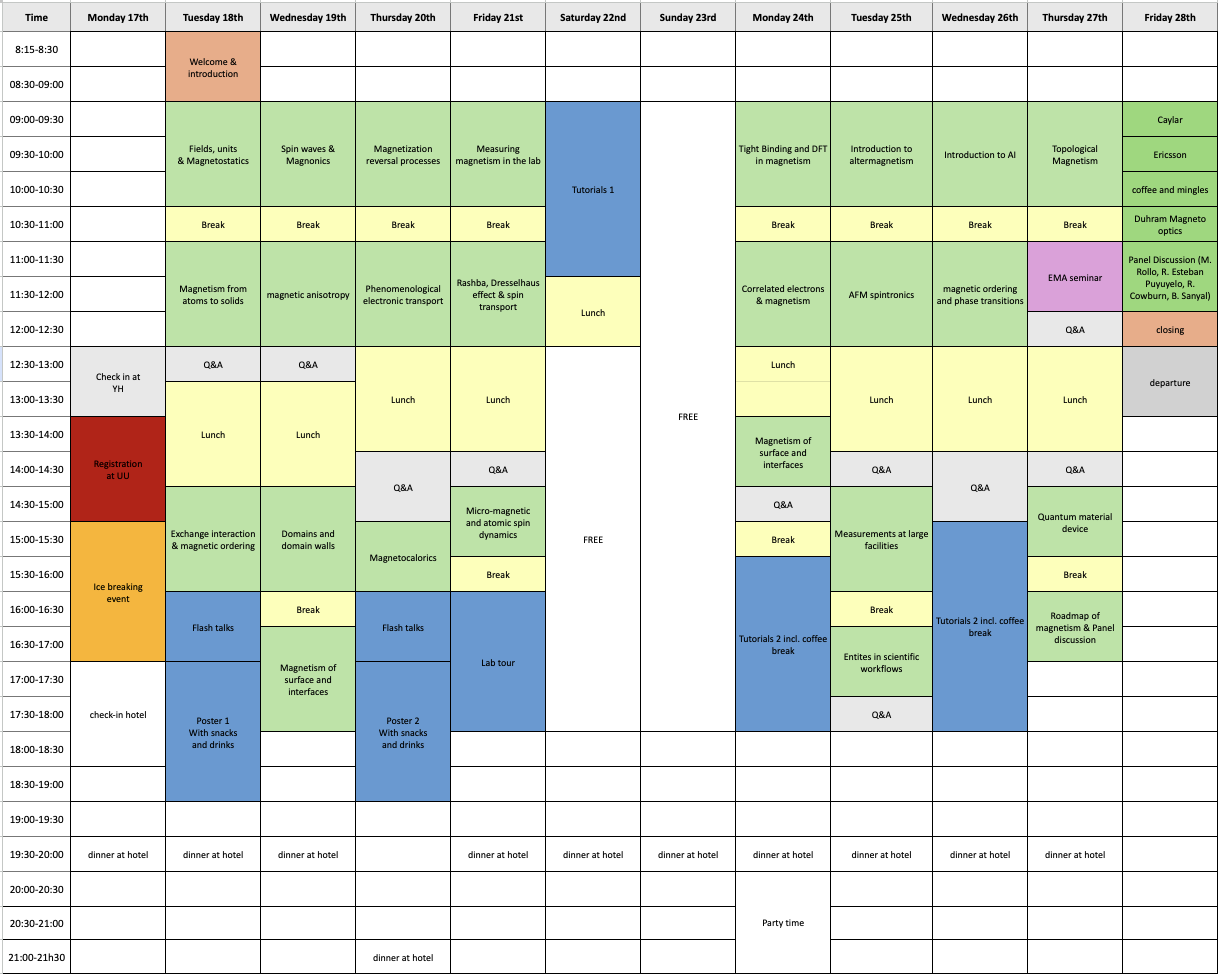
Tentative Program
Accommodation and Social activities
GENRAL NOTE: Cash payment is not common in Sweden. There are many shops even bakeries which do not accept cash (kontantfri butik). You can pay with your phone or credit/debit card.
Housing: Hotell Botanika, Skolgatan 45, 753 32 Uppsala. Accommodation is provided on the basis of rooms shared by several single-gendered participants, to keep control of the costs.
The hotel is in the vicinity of the Linné garden (Linné Trädgraden) a nice traditional garden in the city center. The cathedral (Domkyrkan) and city center with shops and restaurants are in walking distance.
https://destinationuppsala.se/wp-content/uploads/2025/10/upp040-du-vikkarta-2025-tt.pdf
From Uppsala Central Station to Hotell Botanika
Once you rached Uppsala central station to the hotel you can walk to the hotel. It will take about 15 min. Alternatively, you can take any bus from the central station which stops at Skolgatan, e.g. 108 (direction öresundsbro Enköping) or 804 towards Dalby Vik Balingsta. Bothe start from platform C4.
Find your way from the hotel to the university
By foot: Walking takes about 45 min. It is a nice stroll through the old part of the city and along the river.
By bus: You can also take city bus no.8 from Skolgatan (direction Akademiska Sunnersta). Exit at Regementsvägen and cross the street towards the forrest and walk on Regementsvägen for about 300m. Enter the big glas building (house 10).
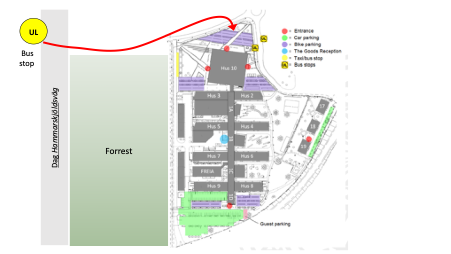
Ångström laboratory
The European School of Magnetism is pleased to welcome participants to the Ångström Laboratory at Uppsala University, one of Sweden’s leading environments for research and education in physics, materials science, chemistry, engineering, and advanced technologies.
Located in the historic university city of Uppsala, the Ångström Laboratory offers modern lecture facilities, research infrastructure, and an inspiring scientific atmosphere. It provides an ideal setting for bringing together students, researchers, and lecturers from across Europe to exchange ideas and explore the latest developments in magnetism.
Address:
Uppsala University, Ångström Laboratory
Regementsvägen 10
752 37 Uppsala, Sweden
Welcome reception (Monday August 17, 2026) and poster sessions – Foyer of house 10—Left of main entrance and the Foucault pendulum
Lectures (from Tuesday 18th onwards) will take place in the lecture hall Sonja Lyttkens, House 10, ground floor